The Awkward Middle of People Ops
Growth exposes gaps long before most founders expect. This post explores the early warning signs that people ops are breaking—and why success, not failure, is usually the cause.
Josh Mueller
5/5/20263 min read
There’s a common belief that companies start to struggle with people operations at 50-100 employees.
In my experience, it happens much earlier.
The break doesn’t come from size alone—it comes from success. A founder builds something that works, demand grows, and the business quietly crosses a line where informal systems stop holding.
The founder can no longer be everywhere.
Ad‑hoc communication starts to fail.
Decisions slow down.
People begin asking the same questions in different ways.
The First Signs Something Is Breaking
When I walk into businesses at this stage, there are a few early signals that almost always show up—often before the owner realizes they’re connected.
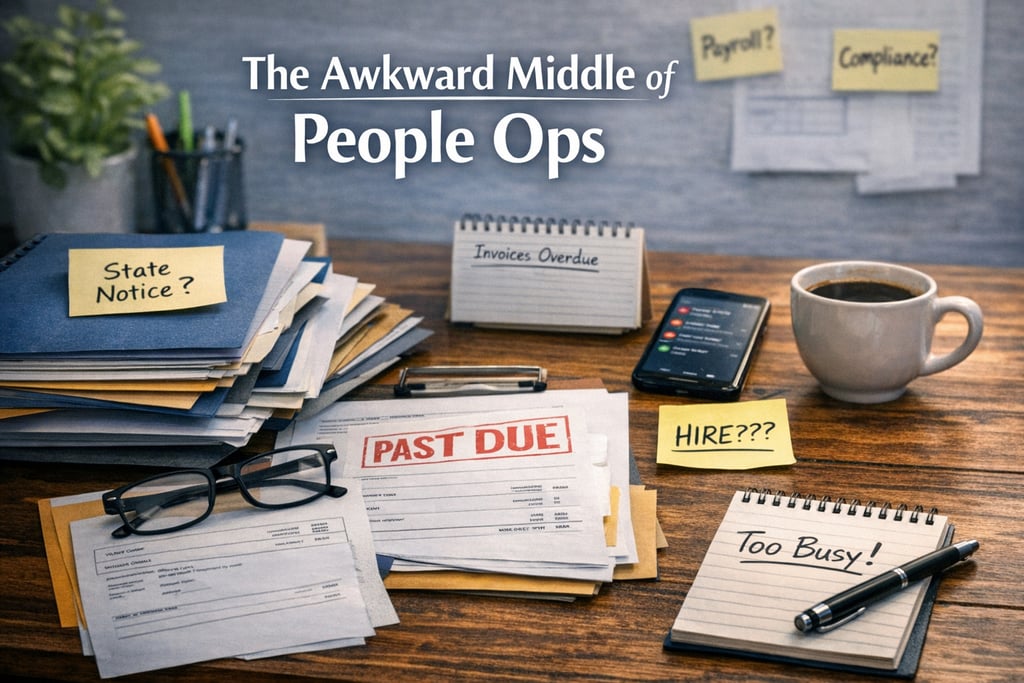
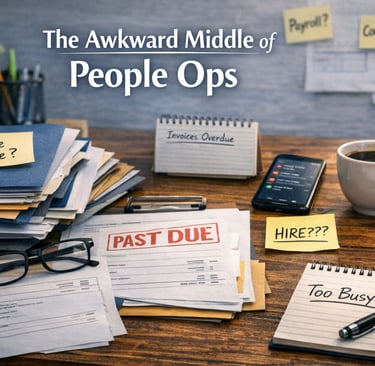
One is notices from states: penalties, compliance letters, or tax issues that land in the mail or inbox, with no clear understanding of what triggered them or how to make them go away.
Another is accounts receivable drift: unpaid invoices creeping up, follow‑ups falling through the cracks, cash flow tightening without a clear operational cause.
A third, and often underestimated, sign is a strategic hire who’s become a burden—someone brought in to help, but who now requires more time and direction than expected.
What all of these have in common is simple:
the owner is drowning—and there’s no system of accountability to absorb the load.
Founders Doing What They’ve Always Done
Most founders I’ve worked with are not ignoring the problem. They’re doing what they’ve always done: covering gaps personally.
Sometimes that’s because they’ve always been the system. Other times it’s fear—adding cost that doesn’t directly generate revenue can feel reckless, even when the alternative is burnout or risk.
Even when problems become visible, the response is often ad‑hoc outsourcing: a payroll service here, a benefits broker there, a bookkeeper or consultant brought in without real coordination. That can temporarily reduce pain, but it often creates a different problem—more vendors, more hand‑offs, and still no clear ownership. The owner’s time is still required to manage, interpret, and connect all of it, which means the underlying bottleneck doesn’t actually move.
This is the awkward middle. The business has outgrown instinct, but hasn’t yet built structure.
The 5‑Person Moment: Start Building for What’s Next
Around five people, it’s time to start thinking less about today and more about the business you’re likely to be running in the next three to five years.
This doesn’t mean hiring a full‑time executive. In many cases, a fractional resource is the right move. Someone who can help an owner:
Put basic systems in place
Create clarity around responsibilities
Evaluate options like a PEO
Build a realistic roadmap that supports where the business is heading
Done right, this phase isn’t about bureaucracy—it’s about preventing future drag.
The 20–40 Employee Shift: A Real Hire Matters
Somewhere between 20 and 40 people, a dedicated hire becomes hard to avoid.
That role might be an office manager. It might be an operations manager. Titles matter less than function. What’s needed is a first line of defense—someone who can absorb day‑to‑day questions and decisions so everything doesn’t default to the owner.
At this stage, everyone taps the founder first. The right hire changes that dynamic.
Earlier in my career, I often played this role myself. I was a bit of a Swiss‑army knife: comfortable with accounting, procurement, IT, and HR. More importantly, I was approachable. Employees were comfortable coming to me first with questions or issues.
That alone created space. Leadership could focus on delivery excellence, sales, and high‑level strategy—without everything stalling on their calendar.
Naming the Stage Matters
This phase isn’t a failure. It’s predictable.
Founders are often excellent at delivering a service and selling it. They don’t start businesses because they love compliance, tax, HR, or budgeting. But success eventually demands those disciplines—whether the owner enjoys them or not.
The challenge of the awkward middle isn’t competence. It’s timing. Waiting too long makes fixes painful. Moving too early creates cost without leverage.
Seeing it, naming it, and addressing it deliberately is what allows companies to grow without becoming unmanageable.
Where This Usually Leads
In practice, the hardest part isn’t deciding whether help is needed. It’s knowing when, and under what conditions.
That’s why I often start with a short, focused assessment before any transition: reviewing employment risk, operating norms, and growth trajectory to determine what makes sense now, later, or not at all.
The goal isn’t to push a solution—it’s to make sure the company’s people infrastructure is keeping pace with how it’s actually growing.