Three Business Books I Keep Coming Back To
A short, personal reading list from years spent building and advising growing companies. Three business books that continue to shape how I think about culture, ownership, and organizational health—and why they’re worth revisiting as a business evolves.
LEADERSHIPCULTURE
Josh Mueller
4/21/20264 min read
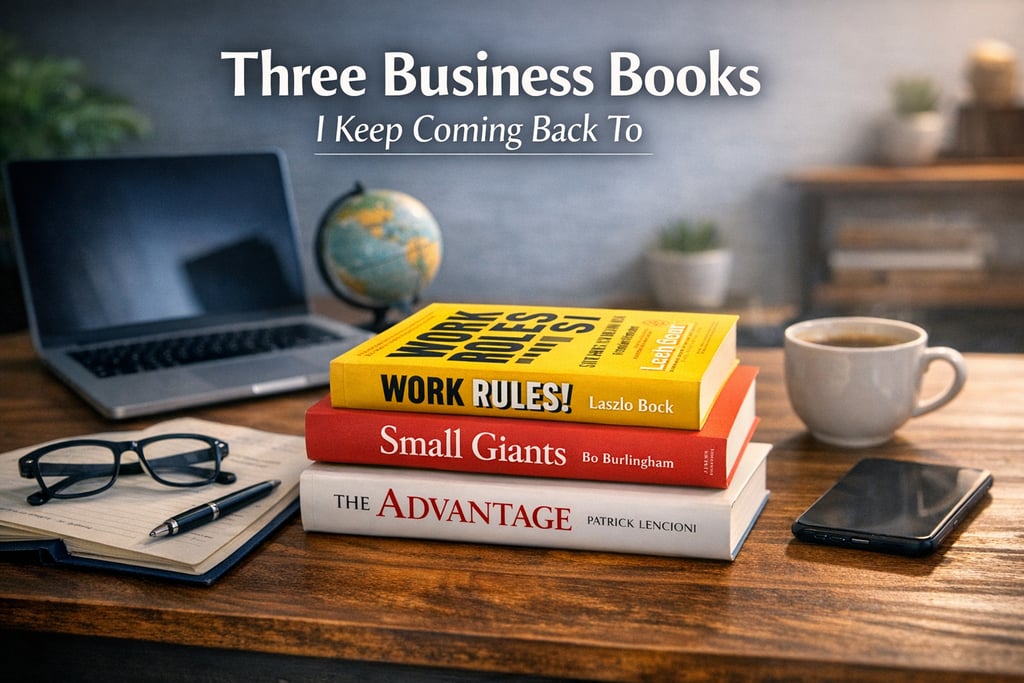
I’ve always read broadly, but when it comes to running a business, a few books have stayed with me long after the pages were turned. Not because they offered clever frameworks or shortcuts—but because they helped shape how I think about people, culture, and decision‑making when the stakes are real.
These aren’t how‑to manuals. They’re books that sit adjacent to running a business. They influence how you lead, what you optimize for, and what you decide not to chase.
Here are five that have had the biggest impact on me as an operator and advisor.
1. Work Rules! — Laszlo Bock
This is the book I most often trace back to two organizations I helped build where owners, employees, and clients genuinely thrived together.
At its core, Work Rules! is about building an intentional culture—one where people are trusted, empowered, given clear expectations, and supported with the right tools. The outcomes of doing this well are almost boringly consistent: engaged employees, better decision‑making, happier customers, and stronger businesses.
What stood out to me wasn’t Google’s scale or perks, but how rigorously Bock connects culture to data, behavioral science, and hiring discipline. Smart people, in healthy environments, doing meaningful work—measured thoughtfully.
What I took from this book and applied repeatedly was the idea that culture is designed, not inherited. When owners commit to clarity, fairness, and trust—and reinforce those values with real systems—the organization compounds in ways spreadsheets can’t capture.
The culture my colleagues and I built, and truly believed in, made both organizations exceptional places to work. While both companies were eventually sold, much of what was built lived on—especially through the people who went on to create strong, healthy cultures in their next chapters. That’s been the most rewarding legacy to see.
But those experiences also made me more aware of how often strong cultures are treated as temporary—something valuable, but ultimately subordinate to growth or exit.
Which leads naturally to the next book.
2. Small Giants — Bo Burlingham
At some point, many successful businesses hit a familiar inflection point. Growth accelerates. Interest from buyers appears. Capital becomes available. And the dominant narrative becomes: sell, scale, dilute, or all three.
Small Giants pushes back on that assumption.
The book profiles companies that actively chose not to become large, publicly traded corporations—but instead focused on being exceptional within a niche. Profitable, durable, purpose‑driven, and deeply rooted in relationships with employees, customers, and suppliers.
What resonated with me is the idea that profitability matters—but it doesn’t have to be the purpose. Some companies choose to maximize impact, quality, or community rather than shareholder value alone.
There’s a real power in deciding:
To control your growth
To remain privately held
To be the place everyone wants to work
Or to be unequivocally the best at one thing
This book confirmed something I’d already felt: selling is not the only definition of success, even when it’s the loudest one.
3. The Advantage — Patrick Lencioni
If I were forced to recommend a single book to small business owners, this would likely be it.
Lencioni argues that organizational health—not strategy, finance, or technology—is the ultimate competitive advantage. And that health is built through a surprisingly simple (and difficult) discipline: clarity.
The model is practical:
Build a cohesive leadership team
Create clarity around purpose, values, strategy, and roles
Communicate that clarity relentlessly
Reinforce it through systems and decision‑making
What stuck with me most was the tremendous value of eliminating unnecessary noise.
In difficult times, this book taught me to ask a simple question:
“What’s most important right now?”
That question became a rallying point. It allowed leadership teams to cut through distraction, move faster, and make decisions with confidence—even when conditions were far from ideal.
Organizational health isn’t soft. It’s structural.
A Few More I Often Recommend
There are many more, but a few others that consistently come up in conversation:
Start With Why — Simon Sinek
Good to Great — Jim Collins
Radical Candor — Kim Scott
Scaling Up — Verne Harnish
Each approaches leadership from a different angle, but all share a respect for intentional growth and human systems.
A Final Note on Reading as an Owner
One thing these books have in common is that they reward rereading. Their meaning changes depending on where you are in the life of a business.
Right now, I’m re‑reading Work Rules! with a more complicated set of questions than I had the first time around. I’m trying to understand how much of its thinking still holds in an era defined by mass layoffs and persistent uncertainty. Since 2020, many employees have operated with a baseline level of fear—jobs feel less durable, careers more transitory, and trust in employers harder to earn and easier to lose. While there are still organizations investing seriously in great cultures, the relentless pressure for higher profits and rising stock prices has made it harder to inspire people, ask for real buy‑in, and lead with confidence. That doesn’t make the ideas in Work Rules! obsolete—but it does make them harder, and arguably more important, to apply well.
For owners and leaders, continued reading isn’t self‑improvement as a hobby. It’s a way to sharpen judgment—to borrow pattern recognition instead of learning everything the hard way.
Running a business rarely leaves much spare time. But the right books have a way of paying that time back many times over.
If you’re building, leading, or deciding what kind of company you actually want to run, these are a good place to start.