
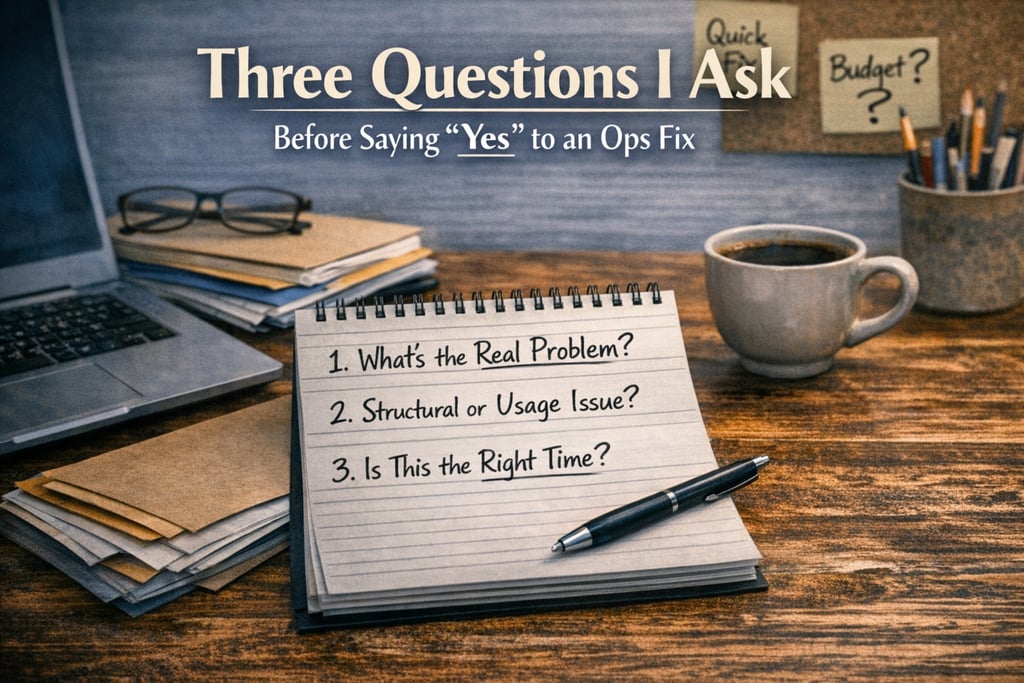
Three Questions I Ask Before Saying “Yes” to an Ops Fix
Most ops fixes fail because the problem isn’t clearly defined. Three questions to bring clarity before taking action.
5/12/20262 min read
There’s a natural instinct in growing companies to fix problems as soon as they appear.
A process breaks, a system feels clunky, a hire isn’t performing as expected—and the reaction is to do something. Add a tool. Bring in a consultant. Restructure the role. Move fast.
Sometimes that’s right.
Often, it isn’t.
Most of the operational work I’ve done over the years hasn’t started with action. It’s started with slowing things down just enough to ask a few simple questions.
These are three I come back to regularly.
1. What problem are we actually trying to solve?
This seems obvious, but it’s usually where things go wrong.
By the time an issue surfaces, it’s already been translated into a proposed solution:
“We need better HR systems.”
“We should switch payroll providers.”
“We need to hire an operations person.”
Those might be the right moves—but they often skip a step.
Underneath the request, there’s usually a different problem:
Decisions aren’t being made consistently
Ownership is unclear
Work is flowing through the founder
Communication is happening informally instead of structurally
If you solve the surface problem without understanding the underlying one, you add complexity without removing friction.
2. Is this a structural issue or a usage issue?
A lot of problems look like tool or resource gaps when they’re really about how the business is operating.
Before changing systems or adding people, I try to understand:
Is the current setup fundamentally broken?
Are we asking it to do something it was never designed for?
Or are we simply not using it the way it was intended?
This shows up all the time—payroll, project tracking, timekeeping, even hiring.
Replacing the system can feel like progress. But if roles, expectations, or accountability aren’t clear, the same issues tend to resurface somewhere new.
Structure scales. Tools follow.
3. Is this the right time to solve this?
Not every problem needs to be solved immediately.
Some need to be addressed early because they create real risk—compliance, payroll, employment basics.
Others are better solved once the business has a level of stability or repeatability.
Move too early, and you add process without leverage.
Move too late, and small issues become expensive ones.
Timing matters more than most people expect.
The goal isn’t to fix everything. It’s to fix the right things, in the right order, at the right time.
A Final Thought
Founders don’t struggle because they’re unwilling to act. If anything, it’s the opposite—they’re biased toward action because that’s what built the business.
But operations doesn’t always reward speed. It rewards clarity, sequencing, and ownership.
Most of the value, in my experience, comes from asking better questions before deciding what to do next.