Why Founders Should Treat Operations Like a Product
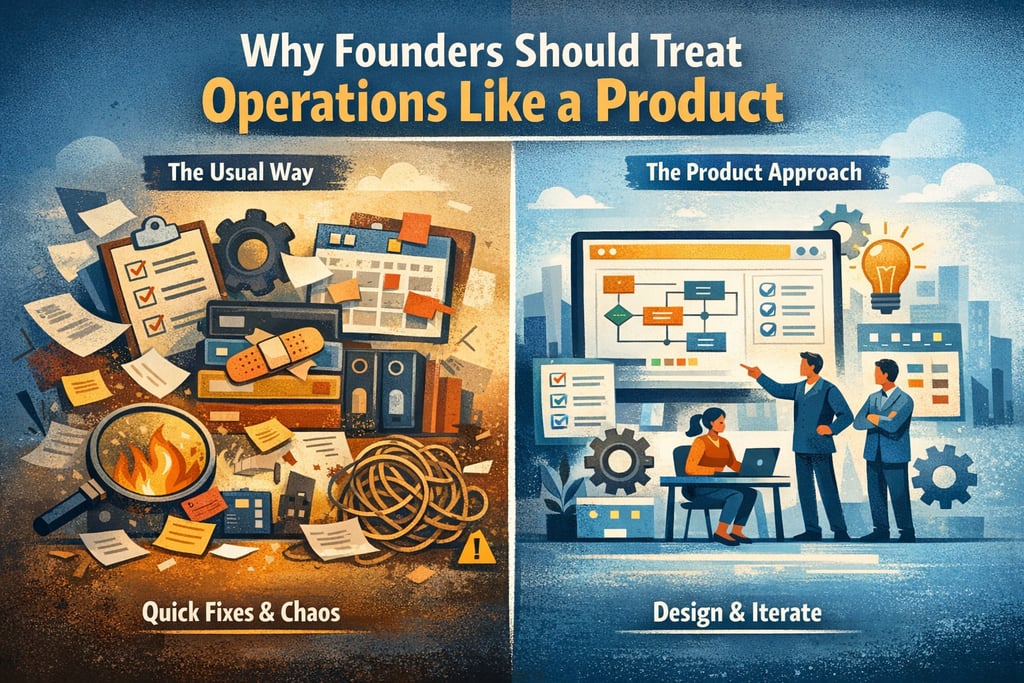
Founders get into trouble when they treat operations as something to patch together with glitter and glue instead of designing and iterating it intentionally like a product with clear ownership, fit, and purpose.
Josh Mueller
5/19/20263 min read
Why Founders Should Treat Operations Like a Product
Most operational problems I see aren’t actually “problems.”
They’re absences.
No insurance. No workers’ comp. No handbook. No documented policies. No budget. No real understanding of spend. No clear system for how work flows from one part of the business to another.
And yet—revenue is coming in. Customers are being served. The business appears to be functioning.
Until it isn’t.
The Problem Isn’t That Ops Breaks—It’s That It Was Never Built
In almost every case, the root issue isn’t that something stopped working.
It’s that operations never really existed in the first place.
You’ve got a founder (or a small group) singularly focused on the product or service. They’re either too busy or too early to prioritize operations. Sometimes they know what’s missing and assume they’ll “get to it later.” Sometimes they just don’t know what’s required.
Either way, it works—right up until the moment the business tries to scale.
That’s when it shows up:
compliance issues
missed obligations
unclear ownership
delays in delivery or billing
customer complaints
contracts falling through
At that point, the instinctive move is: we need to hire someone.
Usually an “office manager” or a generalist who is expected to quietly fix: HR, compliance, procurement, IT, finance…everything.
That almost never works.
What Founders Think Fixing Ops Means
When founders decide to “fix operations,” they tend to reach for a combination of:
hires
tools
templates
or whatever worked at their last company
On the surface, this makes sense. You’re trying to move fast, and these feel like plug-and-play solutions.
But this approach has a flaw: it assumes operations is something you install, not something you design.
You end up with:
expensive tools that don’t fit your needs
processes inherited from completely different companies
fragmented systems with no clear ownership
documentation (if any) that no one actually uses
A clear sign of this: signing up for a costly system because “someone recommended it” or “we had it at my last job”—with no real evaluation of whether it fits your business.
That’s not product thinking. That’s cargo-culting.
What Changes When You Treat Ops Like a Product
When you treat operations like a product, three things change immediately.
1. Someone owns it
Operations isn’t “everyone’s job.” It has an owner, just like a product does.
2. It gets designed—not accumulated
Workflows, handoffs, and systems are intentional. They’re built around how your company actually operates—not copied from someone else’s.
3. It gets iterated
You don’t assume the first version is right. You test, adjust, and refine based on how the business actually runs.
And importantly: it’s built with your culture in mind.
Not every company should operate the same way. Good operations reflects the company it supports.
The Tells: When Ops Is Not Being Treated Like a Product
Most companies don’t need an audit to know something is off. The patterns are obvious.
You know you’re in this territory when:
there is little to no documentation (policies, CRM, contract systems, etc.)
teams are constantly firefighting
the same work is being done multiple times
manual workarounds are holding things together
delays in delivery or billing are chronic and unexplained
staff turnover is high
customer complaints are rising
contracts are falling through
Dig a little deeper and you’ll usually find:
duplication of effort
unclear ownership
no consistent systems
no clear operational philosophy
A more subtle (and dangerous) signal: there is no clear goal or framework for how the business should operate.
The First Steps (You Don’t Need to Overcomplicate It)
You don’t need a massive overhaul to start treating ops like a product. In fact, the first steps are simple.
A few quick wins:
Automate recurring tasks wherever possible
Eliminate low-value activities (too many meetings is the easiest place to start)
Review performance monthly—even a basic cadence helps
Create a simple budget and track it
Standardize documentation and templates
Improve communication channels and operating cadence
And one that’s often overlooked: If you can’t confidently outsource non-core activities—payroll, IT, marketing—you probably don’t fully understand how your operation works yet.
Outsourcing forces clarity. It defines what matters.
The Real Payoff
Treating operations like a product doesn’t make your business “more organized”—it makes it more coherent.
Work starts to move the way it’s supposed to. Decisions feel less reactive and more grounded. Resources get used more intentionally. And instead of constantly holding things together with effort, the system begins to carry more of the load.
Importantly, this shift doesn’t require a massive overhaul or a big investment. In most cases, it starts with a handful of deliberate changes—automating repetitive work, tightening how teams communicate, clarifying ownership, or putting basic structure around how things get done. None of these are flashy, but they have an outsized impact.
Those small improvements compound quickly. You start to see:
fewer delays
clearer accountability
a smoother experience for both your team and your customers
The goal isn’t perfection—it’s momentum.
You don’t scale by adding more people or money to a system that’s barely holding together.
You scale by steadily and intentionally improving the system those people rely on.