
Why PEOs Work—Especially for Distributed, Remote Teams
A practical look at why Professional Employer Organizations work so well for distributed, remote teams—and how they help founders reduce compliance risk, simplify payroll and benefits, and reclaim focus as they grow.
PEOPLE INFRASTRUCTUREEMPLOYER COMPLIANCESCALING YOUR TEAM
Josh Mueller
4/28/20264 min read
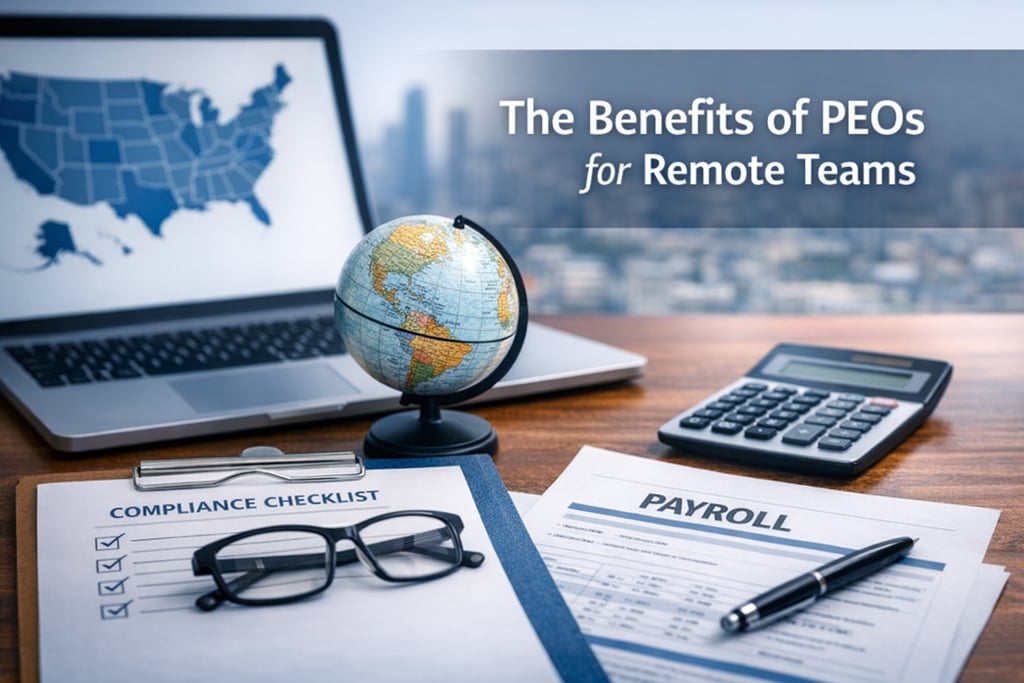
There’s a familiar moment in growing companies with remote teams.
Hiring is working. Payroll runs. Benefits exist. Nothing feels broken.
And yet, in the background, complexity is quietly stacking up.
Multiple states. Different employment rules. Payroll tax registrations. Health plans that don’t quite scale. A growing sense that someone should be watching this more closely.
For founders of distributed teams, this isn’t negligence—it’s the natural result of growth outpacing infrastructure. This is where Professional Employer Organizations (PEOs) can be genuinely useful.
I’ve been a proponent of PEOs throughout my career, not because they’re perfect, but because—used at the right stage—they remove friction and risk in exactly the places founders don’t want to spend their time.
The Real Challenge of Distributed Hiring
Remote work expands the talent pool. It also expands responsibility.
Once a team spreads across states, founders are suddenly accountable for:
State‑specific payroll tax registration, filing, and remittance
Employment laws that vary widely by location
Workers’ comp coverage across jurisdictions
Health insurance options that strain under growth
Ongoing employee questions and administrative edge cases
Individually, these are manageable. Collectively, they create a steady operational drain—especially for owners who would rather focus on customers, hiring, and delivery.
The issue isn’t cost or effort alone. It’s attention.
What a PEO Actually Does Well
PEOs operate under a co‑employment model: the PEO becomes the employer of record for taxes and benefits, while the company retains full control over who it hires, how people work, and how the business runs.
When this model fits, the impact is immediate.
Compliance becomes background noise.
PEOs are built to track federal, state, and local employment rules as they change. That doesn’t remove owner responsibility—but it dramatically lowers the risk of something being missed simply because no one had bandwidth to notice.
Payroll tax risk drops materially.
Payroll tax errors are common and expensive. Under a PEO, filings and remittances run through systems designed precisely for this, supported by teams that do it at scale every day.
Benefits stop being a fragile system.
Because PEOs pool employees across many companies, they can offer stronger, more stable health and retirement plans than most small or mid‑sized businesses can secure on their own.
Founders stop acting as HR clearinghouses.
Employee questions, onboarding details, policy edge cases—these don’t disappear, but they no longer land solely on the founder’s desk.
Why PEOs Have Consistently Worked
Across different companies and growth stages, I’ve seen PEOs work best when founders accept a simple premise:
Employment infrastructure is a specialized discipline.
It doesn’t need to be built from scratch inside every growing company.
PEOs bring pattern recognition, tested systems, and a bias toward compliance that founders understandably deprioritize early. When the alternative is stitching together payroll vendors, brokers, advisors, and best guesses, a PEO often simplifies more than it complicates.
A Few Important Realities
PEOs aren’t universally right.
They don’t eliminate employer responsibility.
They introduce shared control that needs to be understood.
They can be costly if implemented too early—or too late.
And exiting a PEO takes planning.
The risk isn’t using a PEO. The risk is engaging one reactively, without clarity on what problem it’s actually solving.
A Closing Thought
I’ve seen PEOs work best when treated as infrastructure decisions, not HR purchases.
For founders with distributed teams who want payroll, compliance, and benefits handled responsibly—without becoming experts in any of those areas—a PEO can be a stabilizing move.
Not because it solves everything.
But because it solves the right things at the right moment.
Where This Usually Leads
In practice, the hardest part isn’t deciding whether a PEO could help—it’s knowing when, and under what conditions.
That’s why I often start with a short, focused assessment before any transition: reviewing employment risk, operating norms, and growth trajectory to determine whether a PEO makes sense now, later, or not at all.
The goal isn’t to push a solution—it’s to make sure the company’s people infrastructure is keeping pace with how it’s actually growing.
In practice, that assessment has become a short, structured sprint—designed to give owners clarity before making a decision that’s hard to unwind.
A Practical Next Step: PEO Readiness & Growth Ops Sprint
For many owners, the hardest part of deciding whether to use a PEO isn’t understanding what a PEO does—it’s knowing when it actually makes sense, and what needs to be true beforehand.
Over the years, I’ve seen companies move too early, too late, or for the wrong reasons. To help owners approach this decision more deliberately, I offer a short, focused engagement designed specifically for growing, distributed teams.
PEO Readiness & Growth Ops Sprint
Duration: 3–4 weeks
Who it’s for: Owner‑operators of growing companies
Best fit trigger: “We’re growing / hiring / remote—and it’s starting to feel risky.”
What we look at:
This isn’t legal advice or a vendor evaluation. It’s an operational readiness review focused on reducing blind spots before they become problems:
Employment model review
W‑2 vs. contractor usage, state footprint, and misclassification riskHR & compliance baseline
Handbooks, core policies, internal ownership, and gaps (readiness, not formal compliance work)Distributed workforce operating norms
Manager cadence, approvals, documentation, and accountabilityFinance & payroll alignment check
What starts to strain—or break—at 2× headcountPEO decision preparation
When a PEO makes sense, what it doesn’t solve, and how to avoid getting locked in too early
What you walk away with
The goal is clarity, not momentum for momentum’s sake:
A PEO Readiness Scorecard
A 90‑day people & ops roadmap
A clear recommendation: don’t do a PEO yet / do one now / prepare in phases
Why this exists
PEOs can be powerful infrastructure when adopted intentionally. They can also be expensive detours when used as a first response to discomfort.
This sprint is designed to help owners make the decision with confidence—whether that leads to a PEO, a delay, or a different path entirely.
If this situation sounds familiar, that’s usually the right moment to step back and assess before committing.